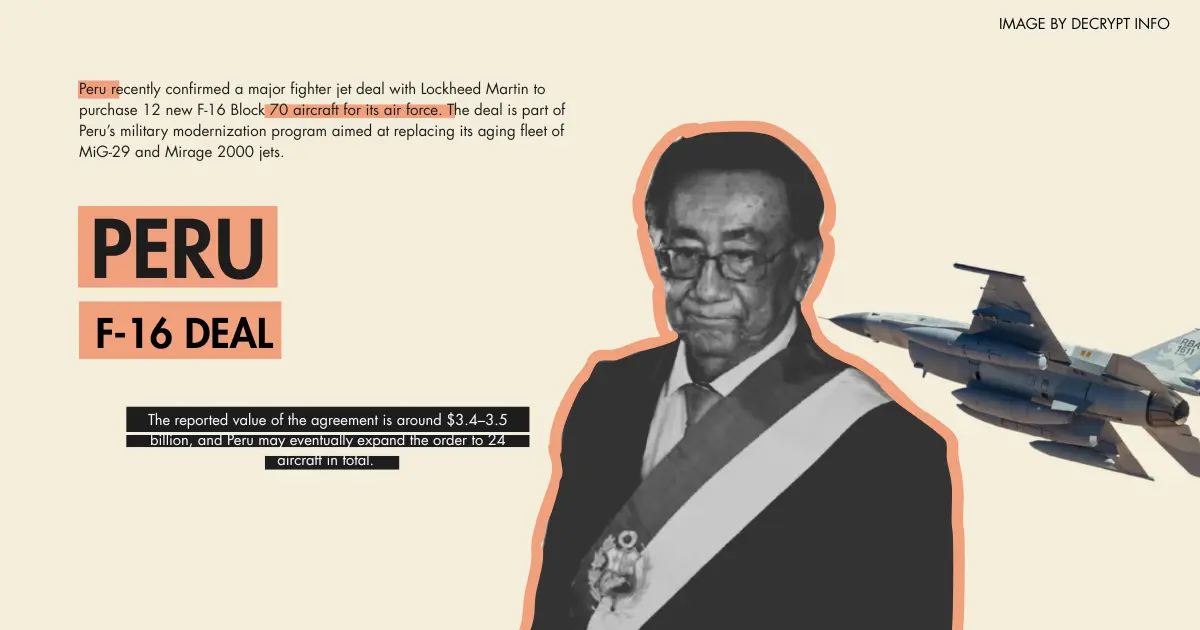
The Peru F-16 Fighter Jet Deal represents a major turning point for a South American country whose economy is largely dependent on natural resources. Peru, whose air force is made up of outdated aircraft and military equipment, has decided to upgrade its air force and signed a deal with its partner the United States for this, which was finally agreed upon after various political upheavals. And according to Reuters, Peru has already paid $462 million for the deal.
What Is the F-16 Block 70 Deal?
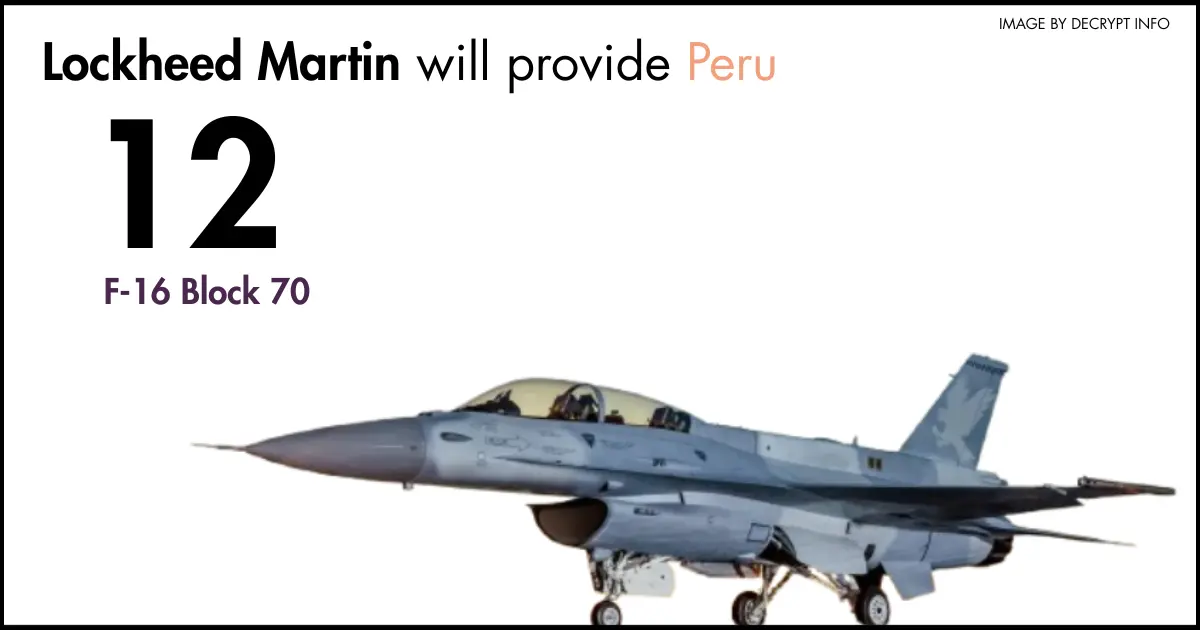
The United States and Peru have reached an agreement under which the American defense and aerospace company Lockheed Martin will provide Peru with 12 F-16 Block 70 fighter jets. It is expected that Peru is interested in buying a total of 24 aircraft, but it will currently receive only 12 aircraft.
Peru has already paid a tranche of the contract, which is worth $462 million. Lockheed Martin has claimed that Peru has now joined the 29 countries that are using this fighter jet, while more than 2,800 F-16 aircraft are operational worldwide.
These modern Peruvian fighter jets will be manufactured at the Greenville Facility.
Why Peru Needs New Fighter Jets:
Peru currently has old-style French and Russian fighter jets, such as the Mikoyan MiG-29 and the Dassault Mirage 2000. That is why Peru wants to acquire F-16 Block 70 fighter jets equipped with modern technology to modernize its air force.
These modern aircraft will be able to help monitor problems such as drug trafficking, while also strengthening its air force and increasing the security of Peru’s airspace.
Peru F-16 Fighter Jet Deal Cost:
According to various sources, the deal between Peru and the United States is being said to be worth between $2 billion and $3.5 billion. On the other hand, according to a press release by the US Defense Security Cooperation Agency (DSCA) on September 15, 2025, a $3.5 billion deal has been signed between the US and Peru, which includes three major US contractors: Lockheed Martin, General Electric Aerospace, and RTX Corporation.
Under this deal, the US will also provide Peru with 10 F-16C Block 70 aircraft, 2 F-16D Block 70 aircraft, 14 F110-GE-129 engines, 12 M61A1 autocannons, AESA radar systems, air-to-air missiles, electronic warfare and countermeasure systems, targeting pods, and secure communication and navigation equipment.
Deal Competitors:
According to Peruvian news and defense media reports, Swedish aerospace and defense company Saab AB and French aerospace company Dassault Aviation also submitted bids for the deal, but according to the US administration, the US came out on top and won the contract.
US Ambassador to Peru Bernie Navarro said the bid was at a very high level, adding that “our fighter jets are technologically very advanced.”
Political Crisis Inside Peru:
A major reason for the first payment of this deal is that two key Peruvian ministers, Defense Minister Carlos Diaz and Foreign Minister Hugo de Zilla, resigned in disagreement with President José Balcázar’s negotiations. President José Balcázar, who had canceled the ceremony for the fighter jet deal a few hours earlier, said he was not terminating the agreement, but rather that the deal would place a greater financial burden on the incoming government, and that he could not make such a major decision.
Washington pressure:
As President José Balcázar canceled the deal, the Trump administration voiced dissent and raised objections. The US ambassador to Peru, Bernie Navarro, posted on Twitter (X) that the US would use “all available means” if Peru was found to be negotiating in “bad faith.”
Why Does the US Support Peru’s Defense Partnership?
The United States does not sell its weapons, warplanes, and other military equipment to every country, but only to those it considers trustworthy. But the question is, does the United States consider Peru trustworthy? The answer is “yes,” because Peru has been a partner of the United States, but the United States does not provide full support to the Peruvian air force or army based on this partnership alone.
There are several strategic and geopolitical factors behind this, due to which the United States is providing this cooperation. The following are some of the key points.
-
Reducing China’s influence:
China’s influence in Peru is significant and growing, which is also a security concern for the United States. China is a major importer of Peru, accounting for more than 20 percent of imports. China also has significant influence in infrastructure projects and the mining sector.
The “Port of Chancay,” which is being built by Chinese companies in Chancay, will connect South America to China and further expand Chinese influence. The United States has already objected to this.
The Trump administration said on social media about the port, “Peru will not be able to control this port because it is under Chinese control and it will weaken the Peruvian government.”
Maria Salazar, chairwoman of the US House Foreign Affairs Western Hemisphere Subcommittee, also warned Peru that it should take back the Chinese port.
-
US arms industry and economy:
This billion-dollar purchase by Peru will benefit and profit the US arms industry, which will also strengthen the US economy. In this way, other countries will also be interested in purchasing from US arms companies, which could prove to be a major economic benefit for the US.
-
Maintenance Cost:
When countries buy warplanes or weapons from the US, they become highly dependent on the US in the future, as the US also provides maintenance and spare parts for these planes. This benefits the US in the long run and strengthens the military ties between the two countries.
Public and Political Reactions:
Some people supported President José Balcázar’s cancellation of the deal, while others opposed it. Some people said that the United States should not interfere in Peru’s internal affairs in this way, to which the US Ambassador to Peru, Bernie Navarro, said that the United States never puts pressure on any country or interferes in its internal affairs.
Final Thoughts:
Peru will certainly upgrade its air force and army after receiving modern warplanes and military equipment from the United States, but according to analysts, the the Peru F-16 fighter jet deal could also prove to be a difficult step for Peru. Because China already has considerable influence in Peru, the question is how China will view this agreement, and how Peru will be able to balance itself between the United States and China.